The Aurelux guide
How to learn Luxembourgish:
where to start
Living or working in Luxembourg, preparing for citizenship, or simply curious about the language? This guide, written with certified teacher Aurélie Wagener, explains what Luxembourgish is, what makes it approachable, and how to make progress step by step — online, for free or with lessons.
- Free to start
- Online or in class
- From first words to the Sproochentest
The language
What is Luxembourgish?
Luxembourgish — Lëtzebuergesch — has been the national language of the Grand Duchy since the 1984 language law. It is a Germanic language, rooted in Moselle Franconian, spoken every day by several hundred thousand people in Luxembourg and the neighbouring border regions.
It sits alongside French and German, the country’s two other administrative languages. Yet Luxembourgish is what you hear at the bakery, at the crèche, between colleagues and in everyday conversation: it is the language of integration, and the only one of the three that most foreign residents never learned at school.
Luxembourgish has an official spelling, last revised in 2019. It borrows a lot from French — people say “Merci”, “Pardon” or “Vëlo” — while keeping a grammar close to German.
Your first words in Luxembourgish
Moien!
Hello! — at any time of day
Wéi geet et?
How are you?
Ech heeschen …
My name is …
Merci, Äddi!
Thank you, goodbye!
Entschëllegt
Excuse me
Schwätzt Dir Lëtzebuergesch?
Do you speak Luxembourgish?
Difficulty
Is Luxembourgish hard to learn?
For English speakers, two things take real effort at first: the grammar, which works like German — three genders (masculine, feminine, neuter) and articles that change with a word’s role in the sentence — and the pronunciation, with sounds like “ë”, “ä” or “ch” that English doesn’t have.
But Luxembourgish has real advantages too. Its core vocabulary is compact and concrete, many everyday words are shared with English, German or French, and its most famous rule — the N rule, which drops a final “n” before certain consonants — can be learned in one well-explained lesson.
Above all, Luxembourgers truly appreciate the effort: a few sentences are enough to change the tone of a conversation. The goal is not perfection, it is daring to speak.
The method
Learn Luxembourgish in 5 steps
This is the order Aurélie Wagener recommends to her students. Each step builds on the one before; once the basics are in place you can work on several at once.
1. The basics and pronunciation
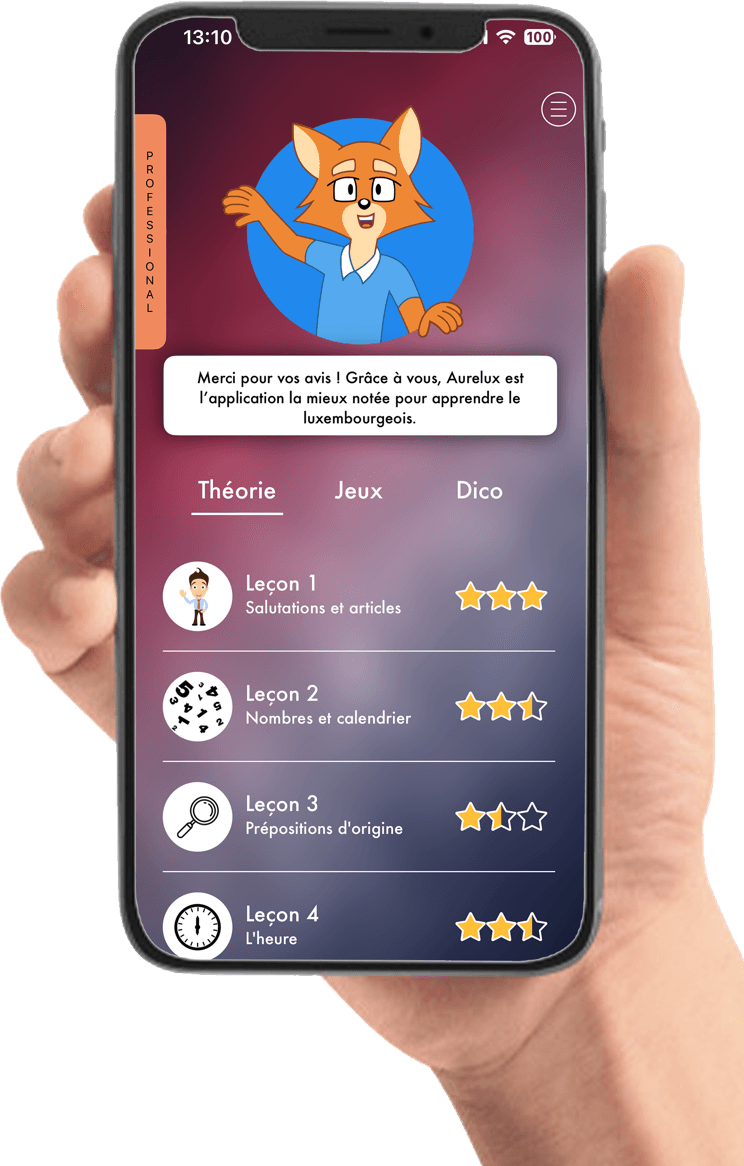
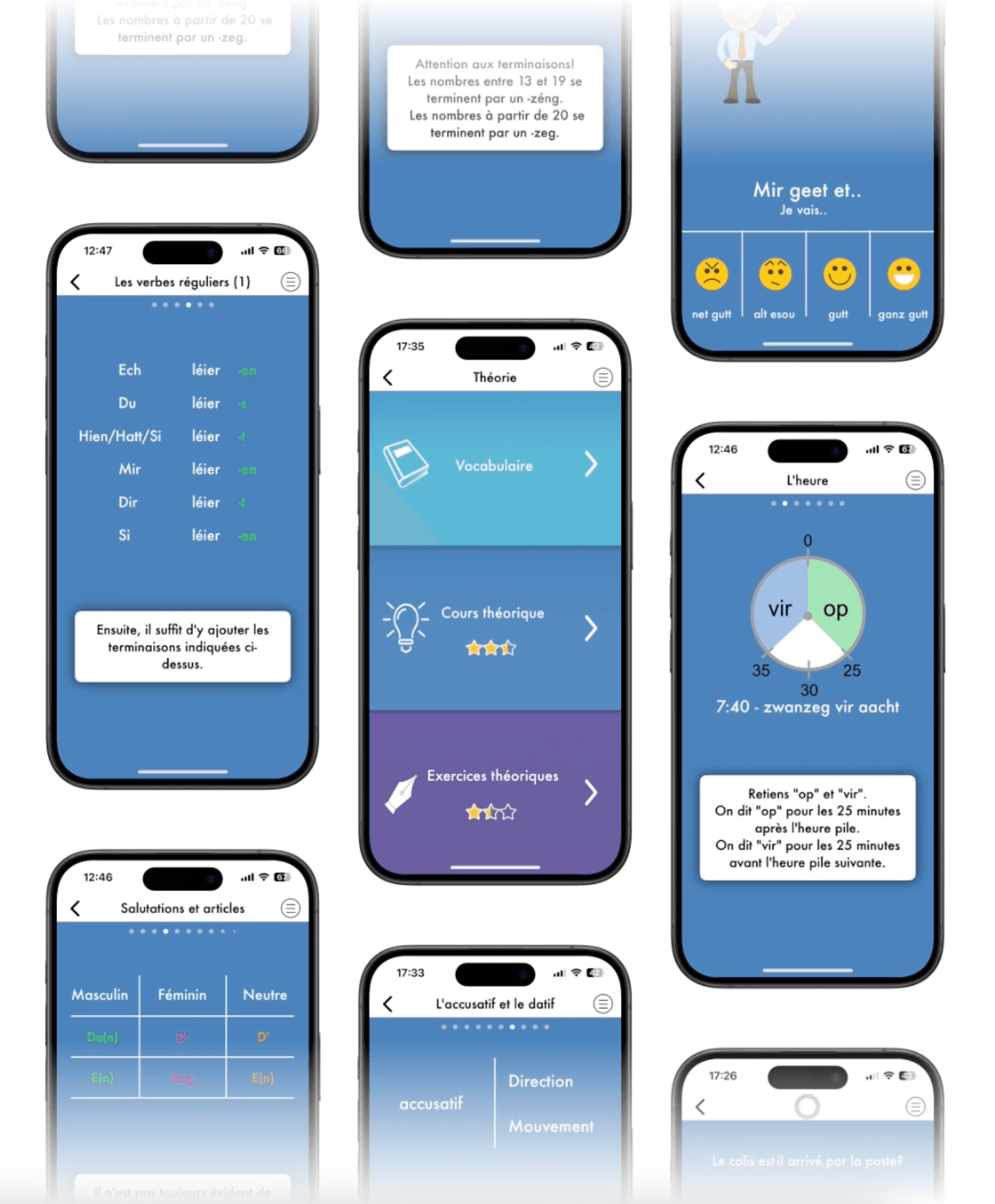
Ten minutes a day is enough to get going. The Aurelux app offers short lessons, real dialogues and pronunciation practice: enough to greet people, introduce yourself and understand everyday sentences.
2. Understand the grammar
Genders, the N rule, regular verbs: better to understand them once than to guess a hundred times. The Aurelux Academy explains them in twelve video chapters, with a workbook.
3. Grow your vocabulary
Vocabulary sticks when you work in small sets and review often. Wuertschatz is built for exactly that: more than 3,000 words and audio clips sorted by theme, with reviews that bring each word back at the right moment.
4. Actually speak
This is the step no app replaces. Luxembourgish courses with a certified teacher — in a small group, at home or online — take you from understanding to conversation.
5. Prepare for the Sproochentest
If you are aiming for Luxembourgish citizenship, the language exam has its own format: a speaking test at A2 level and a listening test at B1 level. The Sproochentest page explains how to prepare.
Free
Learn Luxembourgish online for free
You can get a long way without spending a cent, as long as you practise regularly. The free resources that work best:
- The Aurelux app, a free download on iOS and Android, for lessons, vocabulary and pronunciation.
- lod.lu, the official online Luxembourgish dictionary, with recorded pronunciation for every word and translations into French, German, English and Portuguese.
- RTL, radio and television in Luxembourgish: a few minutes of listening a day trains your ear faster than any exercise.
- LuxQuiz, crosswords in Luxembourgish to revise while you play.
- Language leave (congé linguistique): employees in Luxembourg can apply for it to take Luxembourgish lessons during working time.
FAQ
Your questions about learning Luxembourgish
How long does it take to learn Luxembourgish?
Mostly it depends on how regularly you practise. With daily practice you can handle simple situations within a few months; reaching A2 speaking level, the level required for the Sproochentest speaking test, is a matter of months rather than weeks.
Do I need to speak German to learn Luxembourgish?
No. German helps with some structures, but many learners start from English or French only. Aurélie’s courses are taught in Luxembourgish, French or German, and the Aurelux Academy is available in French and English.
Can I learn Luxembourgish on my own?
The basics, yes: an app, an online dictionary and regular listening are enough to get started. To speak fluently you will sooner or later need to practise with someone — in class, at work or with friends.
Is Luxembourgish useful if everyone speaks French or English?
Yes. French and English get you through many situations, but Luxembourgish opens up social life, makes integration at work and school easier, and is required for Luxembourgish citizenship.
What level do I need for Luxembourgish citizenship?
The Sproochentest requires A2 level in speaking and B1 level in listening. There is no written test.


Start today, for free
Download the Aurelux app and learn your first Luxembourgish words in ten minutes. When you are ready to speak, Aurélie is waiting for you in class.